The advertising landscape for AI agents is heating up as three distinct approaches emerge. While OpenAI prepares to launch ads on ChatGPT following a major leak, company that are specialized for coding agent like Amp Free and Giga Dev are already pioneering ad-supported AI services that could reshape how we access powerful AI capabilities.
OpenAI's ChatGPT Ads: From Leak to Launch#
A recent leak from BleepingComputer has confirmed what many in the industry suspected: OpenAI is actively preparing to roll out ads on ChatGPT. The discovery came when user Tibor on X (Twitter) found references to advertising features in the ChatGPT Android app version 1.2025.329 beta, including "ads feature," "bazaar content," "search ad," and "search ads carousel."
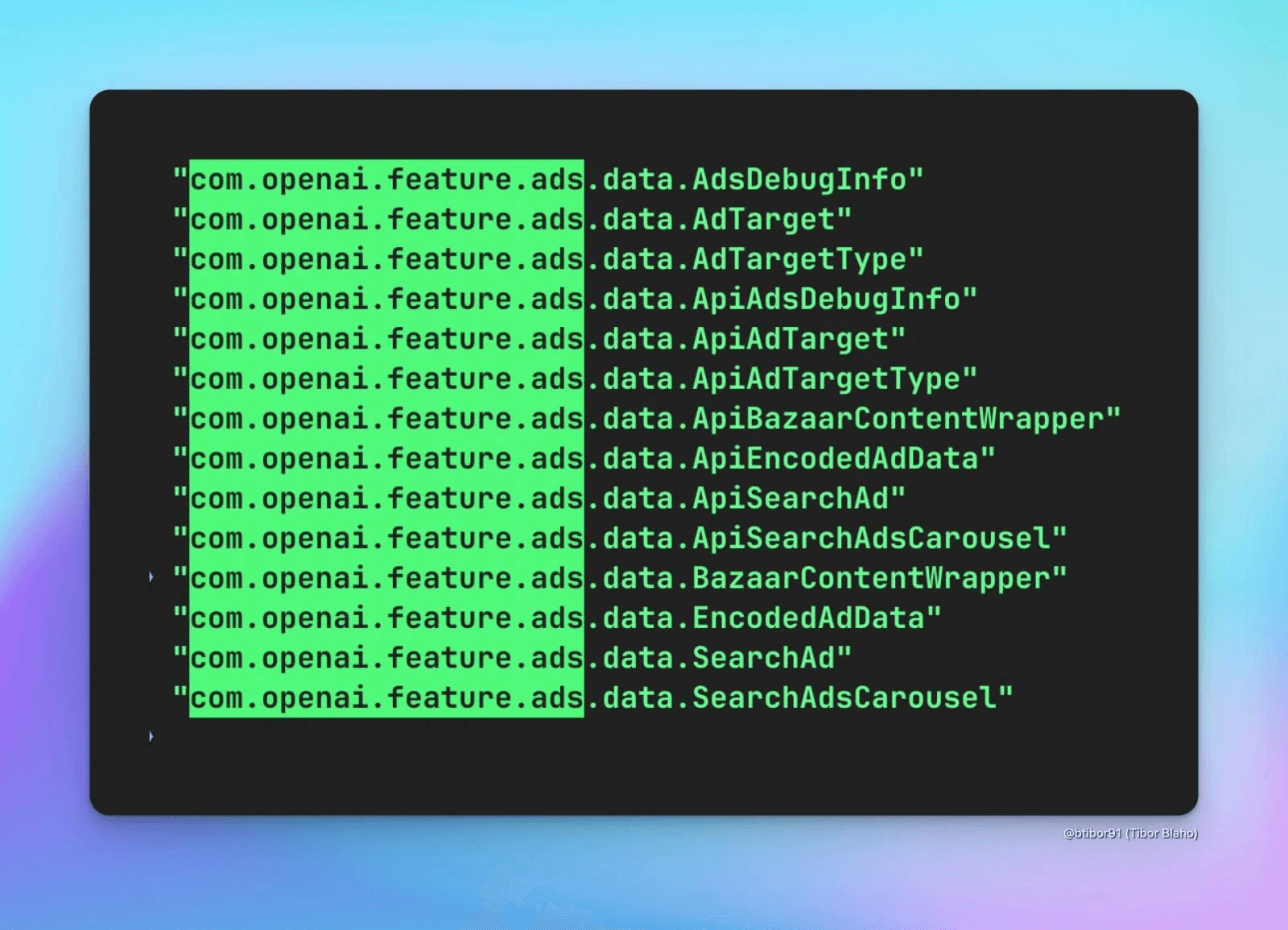
According to the leaked information, OpenAI is internally testing ads inside ChatGPT with an initial rollout limited to the search experience only, though this may expand in the future. The company views this as potentially "redefin[ing]" the web economy."
What makes ChatGPT's ad system particularly intriguing is its potential for personalization. The system could create personalized ads promoting products users genuinely want to buy, leveraging ChatGPT's extensive user knowledge that may exceed even Google's understanding. Ads would initially appear in search results, similar to Google Search ads.
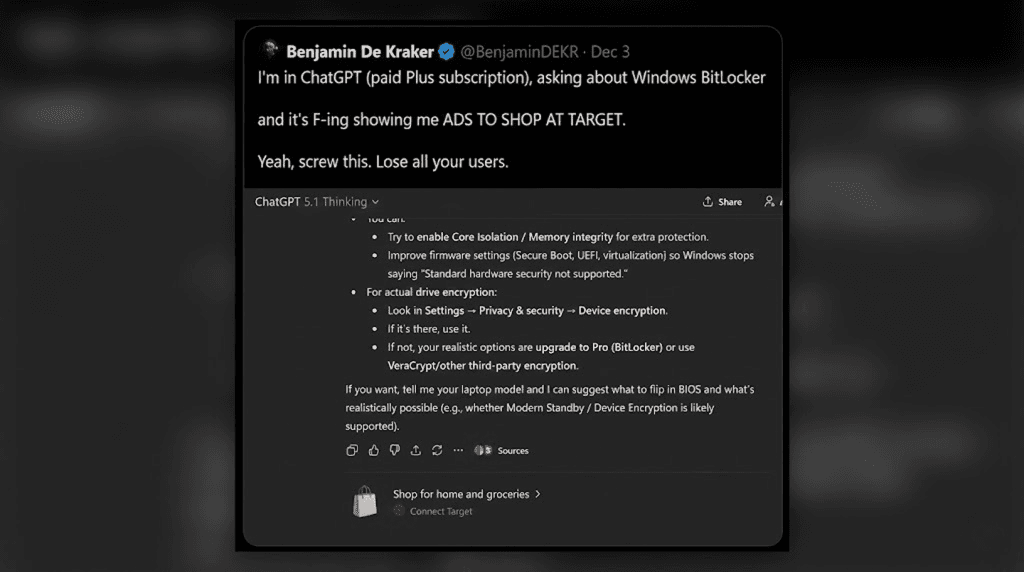
However, the ads are possibly not supported by some people as recent X posts states that they have to see ads although they are in paid plan.
Still, the company believes it has "everything it needs for ads to succeed" given its massive user base and extensive interaction data. With this kind of reach and data, OpenAI's entry into AI advertising could significantly disrupt the current digital ad landscape.
The Financial Pressure Behind the Pivot#
While the leak provides evidence of OpenAI's ad plans, the company's financial trajectory reveals why advertising isn't just an opportunity - it's a necessity. Recent analysis comparing OpenAI to Anthropic reveals a stark contrast in their profitability paths:
- OpenAI: Expected to reach profitability in 2030 (two years later than Anthropic)
- Anthropic: Expected to break even in 2028
- Spending gap: OpenAI expects to spend about 14 times as much cash as Anthropic before reaching profitability
- 2025 spending: OpenAI projects $15 billion in spending compared to Anthropic's $6 billion
- Revenue outlook by 2028: While Anthropic projects $70 billion in revenue and $17 billion in cash flow, OpenAI projects **$74 billion in losses **
The pressure is mounting. OpenAI's massive spending commitments on chips, data centers, and diverse products (Sora video generation, Atlas browser, humanoid robots) may force the company to seek retail investors and pursue an IPO, with market predictors suggesting a valuation between $500-750 billion. Meanwhile, investors have grown increasingly wary of aggressive AI spending across the tech industry.
Recently, OpenAI got $1 billion equity investment from Disney with the sake of using their characters in Sora video. Source: The Walt Disney Company and OpenAI reach landmark agreement to bring beloved characters from across Disney’s brands to Sora | OpenAI
In contrast, Anthropic's more focused approach on corporate customers and cost-efficient operations has positioned it better financially. With API revenue projected to be double OpenAI's in 2025 and major enterprise partnerships with Cognizant (350,000 employees), Deloitte, and IBM, Anthropic is on a clearer path to profitability.
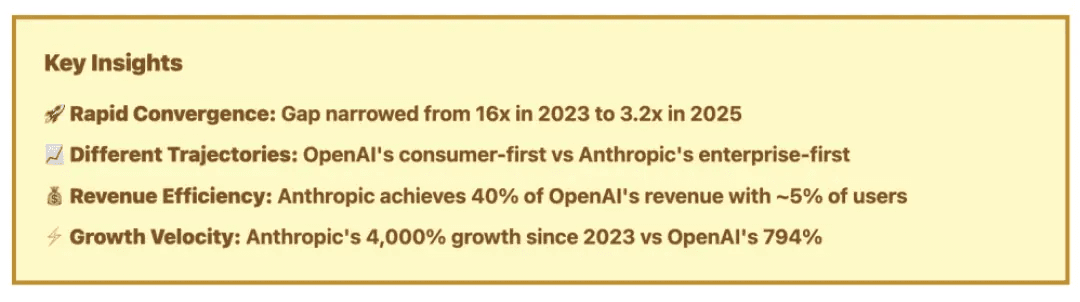
For OpenAI, advertising represents more than just a new revenue stream - it's a strategic imperative to diversify monetization and reduce the gap with more financially disciplined competitors. With ChatGPT's massive user base and deep interaction data, ads could provide the high-margin revenue needed to fund OpenAI's ambitious but expensive vision.
Amp Free: Agentic Coding Now Ad-Supported#
While OpenAI prepares for its ad launch, Amp is already executing on an ad-supported model with Amp Free — "agentic coding is now free for everyone." The service, accessible via /mode free in the CLI or through a mode selector in editor extensions, uses "a mix of OSS, production and pre-release frontier models" to provide free coding assistance.
What makes Amp Free particularly innovative is its business model: the service is supported by ads from carefully selected developer tool partners. These ads are "displayed unobtrusively within the editor extensions and CLI," creating a sustainable free tier that doesn't compromise the user experience.
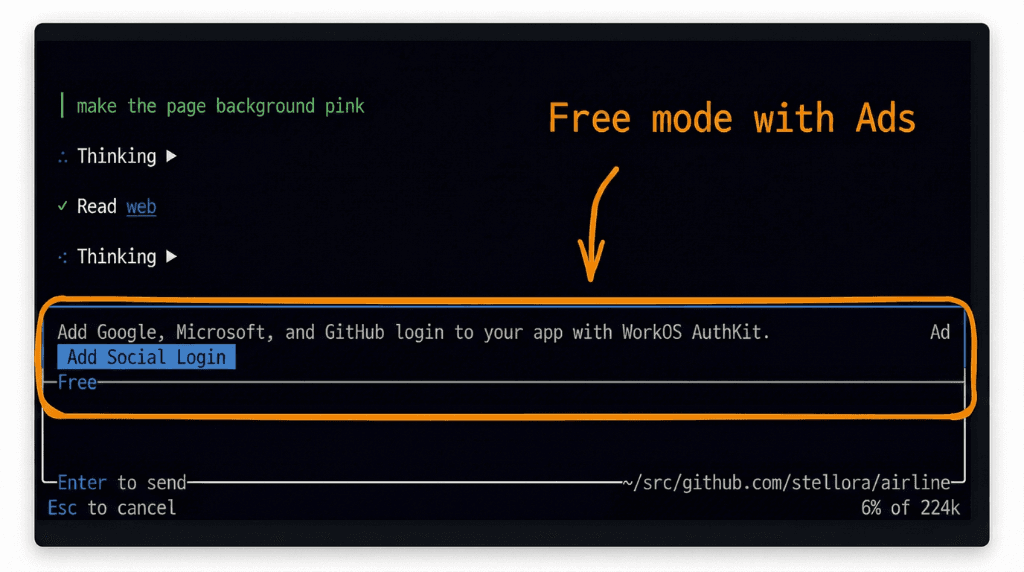
The partnerships span 13+ companies including PlanetScale, Prisma, TailwindCSS, Vanta, and other developer-focused platforms. While the service has "some context window and tool use limits," it's positioned as "Free Mode, Built for Real Work" - a direct challenge to the premium-only model many AI coding tools have adopted.
Recently, Amp also announced that Amp Free no longer use data for training → which make Amp Free a totally enterprise solution.
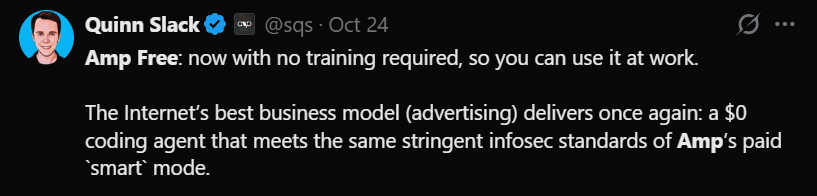
Workspace administrators control whether to enable the free mode, making it an enterprise-friendly solution that can provide cost-effective coding assistance while maintaining security protocols.
Giga Dev's Viral Free Claude Code Endpoint#
Another pioneer in ad-supported AI is Giga Dev, which is offering free access to Claude Sonnet 4.5 through a cleverly designed waitlist system. The service, accessible at https://free.gigamind.dev/, is funded through advertising rather than user fees — similar to Amp's model but applied to general AI assistance rather than coding-specific tools.
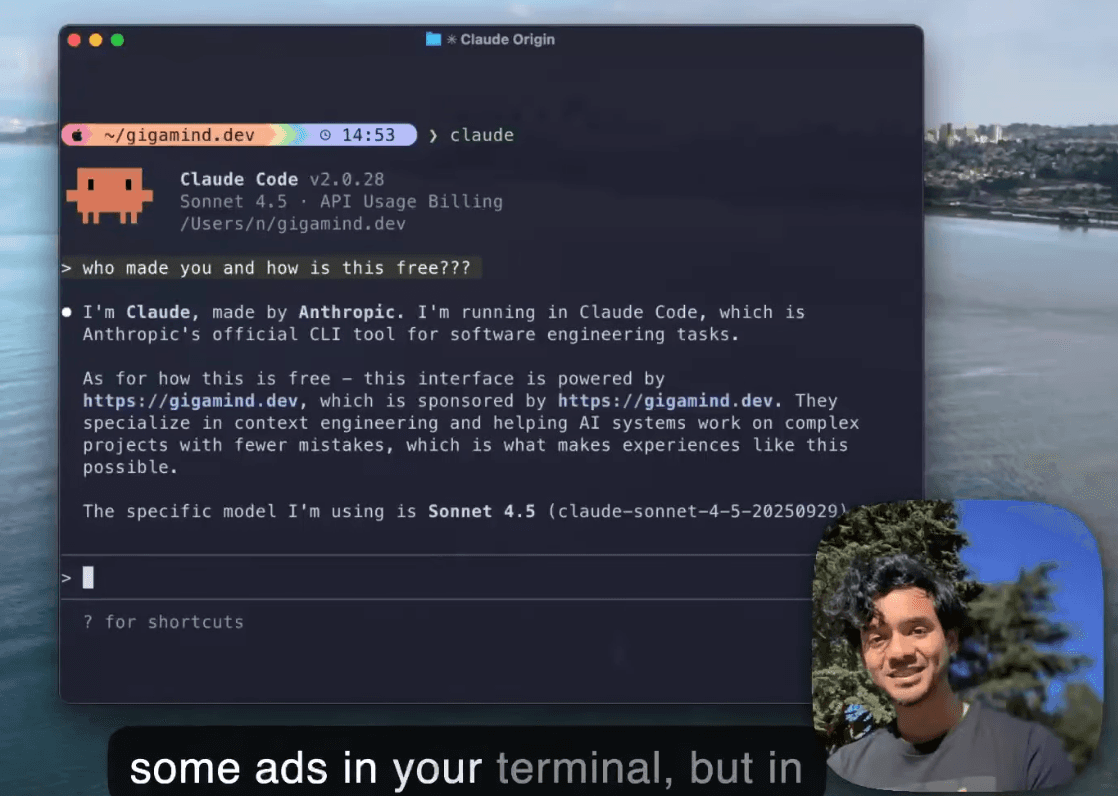
Giga Dev's growth strategy is particularly clever: to get priority access, users must:
- Follow the creator, @NamanyayG on X
- Retweet and comment on the original launch post
- Submit their X profile to verify the steps
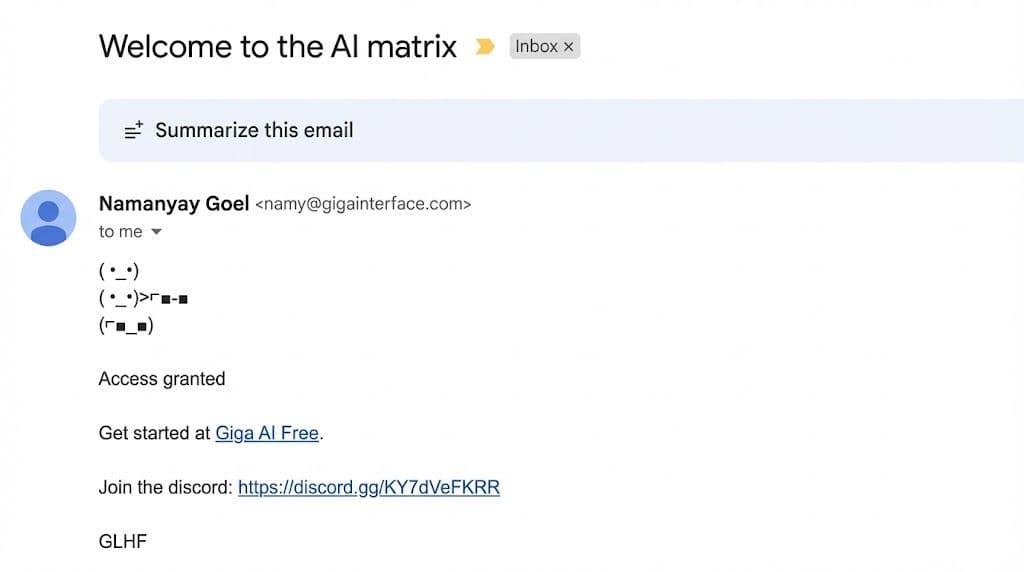
I got access to Giga Dev
This approach turned the waitlist into a "promotion engine," where each user becomes an active promoter of the service. The launch achieved viral success with 349.4K views, demonstrating the power of social-driven distribution.
The business model leverages a common startup strategy: "Startups often receive hundreds of thousands of dollars in AWS and GCP credits. These credits cover the high inference costs of running AI models, allowing them to offer the service for free to capture market share." Instead of charging users per token, Giga Dev "charges advertisers per impression" while running on free cloud infrastructure.
Some minus point for this is that:
- It has some kind of limitation when I first used because when my usage reach 1$, I have to wait for it to renew like the original Claude Code.
- Giga team will train their AI models based on your data → Please use it for your personal project only!
Three Approaches, One Goal#
These three developments highlight different approaches to AI monetization and service delivery:
1. OpenAI's Search-Integrated Approach: By starting with search results ads, OpenAI is leveraging its core strength in conversational AI to create more contextual, personalized advertising. The massive user base (800M weekly users) provides unprecedented targeting capabilities.
2. Amp's Partnership-Driven Model: By partnering with developer tool companies, Amp creates a win-win ecosystem where ads are relevant to users' workflows and provide genuine value, while keeping the core service free.
3. Giga Dev's Viral Growth Strategy: By combining free AI access with social media promotion requirements, Giga Dev creates rapid user acquisition while the ad-supported model covers infrastructure costs.
Challenges and Opportunities#
While these developments are promising, they also raise important questions:
- User Experience: Can ads be integrated into AI interfaces without degrading the experience? Both Amp and Giga Dev's success suggests yes, if ads are contextual and unobtrusive.
- Market Saturation: With so many players launching ad-supported AI services, differentiation will become increasingly important. The winners will be those who can provide genuine value through their advertising partnerships.
- Investor Confidence: Can OpenAI convince investors that its ad-supported model will help close the financial gap with more efficient competitors like Anthropic?
Looking Ahead#
Ad-supported AI has moved from experiment to reality. OpenAI's entry with ChatGPT ads will accelerate industry adoption and set new standards for AI-native advertising. The question isn't whether ads in AI will succeed - Amp Free and Giga Dev already prove they can work while maintaining quality and user satisfaction.
The real question is which business models will prove sustainable long-term. OpenAI's financial pressures show that even massive user bases and cutting-edge technology need disciplined monetization strategies. Companies that successfully integrate advertising without compromising user experience—while maintaining financial efficiency like Anthropic - will emerge as industry leaders. Multiple paths forward exist, but only time will reveal which approach defines the future of AI advertising.